Till was set to first watch after the searchers departed, and the knights laid themselves down upon the heath. Yet Nikolaos, the Dove Knight, woke before dawn to the sound of heavy snoring. Till had fallen asleep at his post.
Worse still, someone had rifled through Nikolaos’ pack. The herbs he carried to kindle flame were gone.
Till bore the shame in silence. The company rode on along the coast without breaking their fast, seeking the Drowned Seer.
By midday they glimpsed a clutch of trees and a furrow in the earth from which issued a strange and ceaseless murmur — as of a thousand twigs ground together. Drawing nearer, they beheld a river. Not of water, but of bones. It coursed pale and clattering toward the sea.
In dread they followed its path inland.
There they found a small gathering of gaunt folk beside a pond, kindling a pyre. The knights rode toward them at speed, but the thin wretches stepped forward and bade them still their mounts, dismount, and show reverence.
They were acolytes of the Drowned Seer. The pyre had been prepared as offering. Kneeling beside the pond, they posed their questions to the water.
The knights did likewise.
From the depths came a voice, distant and distorted, as though it had travelled far through water.
“Welcome, knights. It has been long since I beheld your kind.”
They asked of the risen dead and of bones that thrust upward from the soil. The Seer answered only this: that the dead envy the living, and that the dead must die again. There is no other path.
He warned them, too, of other perils in the Meadowlands — things that cast long shadows, that scented their presence, that wished to test them, to behold them, to hear their defiance.
When asked of the river’s source, the Seer told them simply: follow it, if you so desire.
That night the knights camped near the pond and shared the provisions granted them in Crownsford with the acolytes. The thin folk thanked them also for their offering of the previous night — which had fed the pyre well. Nikolaos did not receive this gratitude kindly.
By morning the river of bones had dried, yet its furrow remained. They followed it back to a place they knew: the quarry beside the garrison they had stumbled upon days before.
They descended into the quarry, leaving their horses above — save for Nikolaos, whose mountain steed trod sure-footed down the slope.
There they found bones thrusting from the earth in strange formations, like pale flowers in bloom. Garth perceived they might be loosened. Till, with Cedric’s aid, wrenched one free.
A crack resounded.
The ground gave way.
They fell into darkness.
Below lay a vast chamber, daylight a distant and unreachable ceiling far above. From dust and shadow emerged six undead beasts — some winged, some bearing great bone-clubs, others with the dreadful claws they had faced before.
The battle was terrible.
Garth’s fury burned white as he hurled smiting blows with little effect. Till rushed forward and slew one, only to be struck down as before, mortally wounded upon the stone. It became a war of attrition.
Nikolaos leapt upon his wings, descending again and again with blade flashing, but he too suffered grievous wounds and fell from the fight.
Cedric, exhausted from turning aside killing strikes meant for his brothers, staggered and nearly collapsed before he and Garth at last brought down the final foe.
They were broken and bloodied. No path upward could be seen.
Yet Nikolaos was restored to breath. Binding himself to his mountain steed, he urged the creature to climb.
With impossible grace it leapt from ledge to narrow ledge along the chamber walls and bore him out into daylight. From there he summoned aid from the garrison, and the others were drawn up by rope.
After a night of rest and warm food, they resolved their course.
Cedric was certain: the place must be cleansed. They must descend again.
The garrison’s sergeant could scarcely comprehend such resolve. He would not send his men below, yet he ordered ropes set and watch kept above, that the knights might flee if fate turned against them.
Thus the three knights and their squire descended once more, bearing torches given by the soldiers and holding their oaths close in mind.
At the chamber floor they knelt together, lit their flames, spoke their pact against the darkness, and rose.
From a tunnel leading into the hall came two twisted abominations — extra-limbed, clawed, and wreathed in unnatural fire.
“Do not let them leave the tunnel,” Cedric cried.
They charged and held the creatures fast within the narrow passage. Flame was hurled down the corridor, yet Cedric cast himself before his companions and turned the blaze aside.
Both were slain.
They pressed further into darkness, guided only by torchlight. The passage widened. Their voices echoed back to them. A chamber greater still lay ahead.
More of the undead waited there.
But now the knights did not falter. Steel rose and fell without hesitation. Bone shattered. The dead were struck down and given no quarter.
When the chamber was quiet at last, Cedric searched the hall and the adjoining passage. There he found a great tapestry — silken, purple, threaded with silver. It depicted an ancient scene of unknown figures and forgotten heraldry, the sort that might once have hung in the high hall of a wealthy lord. Its age and craft spoke plainly of lost nobility.
They also discovered a stone stair concealed in shadow. It wound upward in darkness.
They climbed until it ended at a hidden door set into the side of a hill.
When it opened, daylight greeted them.
They stood outside once more, near the quarry and the garrison.
The tapestry was presented to the soldiers. The men cheered, their spirits lifted by proof that something of worth had been wrested from beneath the earth. The sergeant, heartened by their success, pledged to send word of their deed to the king and asked in which direction the knights would next ride.
They answered: southeast, in search of further seers and cities yet unknown.
Reinforced by the sergeant and a handful of willing men, they returned below one final time and swept the remaining chambers clean. No more undead stirred.
Yet they found heavy tracks in the dust — the imprint of something large, like a man shod in iron boots. The prints led out of the catacombs.
Later that same day, riding southeast, they came upon a farmstead burned to ruin. The houses were ash. The animals lay dead. No soul had survived.
Nikolaos bore the sight heavily, for it echoed wounds of his own past.
They found the same iron tracks leading onward.
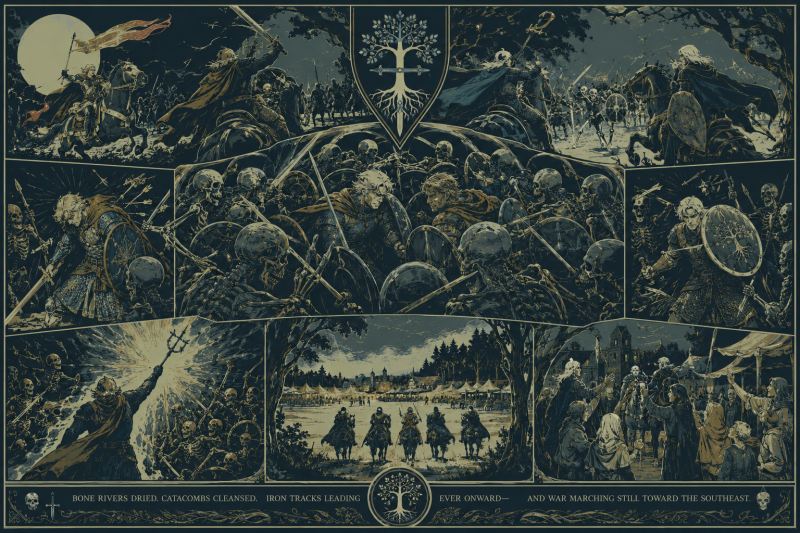
Following them across a river and into gathering dusk, they beheld their quarry: a dozen armed undead soldiers marching in formation. Slow. Steady. Silent as the grave. They moved southeast.
The knights hesitated. Yet they knew such a force would bring slaughter upon the next settlement.
At nightfall they struck.
Garth and Till charged from behind, while Cedric and Nikolaos rode from either flank. Their intent was to ride through, striking with smite and blast, wheeling away before the enemy could answer.
But Garth and Cedric were caught within the press as the skeletons locked shields into a wall of bone.
Garth suffered grievous blows. Cedric turned aside many strikes, though his guard thinned with each passing breath.
At the last, Garth unleashed a furious smite — a blast of righteous force that shattered the remaining undead where they stood.
Silence followed.
Ahead, not far beyond the treeline, lay a market dwelling upon the forest’s edge. The skeletons had been minutes from reaching it. They would have attacked in the night, when all slept.
The knights rode on and were received by those they had unknowingly saved.
Thus ended their second chronicle in the Meadowlands: bone rivers dried, catacombs cleansed, iron tracks leading ever onward — and war marching still toward the southeast.
Add comment
Comments