The company rested beside the market village, near the place where they had cast down the shambling dead. Yet the folk they had saved were not so grateful as a tale might prefer. Fear had not made them noble, only sour, and they seemed scarcely to understand how nearly death had taken them all. Thus the knights found little honour in that place, though they had purchased the villagers’ lives with steel and peril.
It was there that Cedric was seized by vision.
Whether some old power of root and leaf had called to him, or whether the forest itself had opened and made demand of him, none could say. He spoke only briefly, telling Tyll that he would rejoin them later, for he now knew the direction of the evil isle they sought. Then he wandered alone into the great wood. Before their eyes he became one with its living substance, passing into green shadow and tangled growth until no sign of him remained.
Thus Cedric was not lost as men are lost, but taken as the forest takes rain, or light, or bone.
Later that same morning another knight came by river from Crownsford, borne in a flat-bottomed boat as though delivered by fate rather than chance. This was the Moss Knight, come down from the northern country, sent into the Meadowlands as the others had been: to seek out the myths and, if he could, preserve the kingdom from the dark things gathering against it.
He was a hard man to behold. A mail hood covered his head, and a long sidemantel hung from his shoulders. His upper body was marked with bright serpents tattooed across scarred and burned flesh, as if old fires and older gods had both laid claim to him. He rode a pale horse and bore a plain wooden cudgel and a buckler. He was no courtly champion fresh from song, but a man weathered by violence and shaped by survival.
At the riverside he met Nicolaus, who had been cooling in the water the skin that flame had once ruined so cruelly. They exchanged their names, and when the Moss Knight came on to the village he found Garth and Tyll there also. Since all were bound upon the same errand, it was plain they should ride together.
But Cedric did not return.
So the company spent another uneasy night in the market village, and when dawn came pale and uncertain, they went into the forest without him, seeking the lake that was said to hold within it the evil isle.
Within the wood they found a glittering path, winding between the trees like a fallen ribbon of stars. Yet the Meadowlands had already taught them caution, and none among them mistook wonder for safety. The Moss Knight entered a trance beside a great oak and sought the counsel of that ancient tree, asking whether the shining road led to danger or to triumph.
For a long while the oak gave no answer. Then at last it spoke, saying that both awaited at the path’s end, and that “the little benefactor” had been there again.
What this meant none could rightly say, but it was enough to sharpen their wariness.
Still they chose to follow the path. Yet scarcely had that choice been made before Tyll, moved by greed or curiosity or some lesser madness, threw himself down and scooped at the glitter with both hands. At once the shining dust flared alive. Five great wandering flames sprang up and hurled themselves upon the company.
The horses panicked. The knights scattered and cursed. Nicolaus, who had suffered more from fire than any man should, was struck with especial terror. Yet though the flames burned and singed them, they did not destroy them. Soon enough both the fires and the glittering road vanished together, leaving the company blackened, chastened, and feeling somewhat mocked by the wood.
So they made their road by common means thereafter.
That night they rested beneath a vault of interwoven branches in what seemed the ruins of some ancient monument. There stood a stone altar, worn by years beyond memory. Whether it had once served prayer, sacrifice, or judgement, no man could tell. The place was old enough that its purpose had gone from the world, though its solemnity remained. There the knights took uneasy sleep.
On the following day they reached the lake and made their way along its northern shore.
There stood the Bone Slayer.
He waited in utter stillness, with his monstrous sword levelled in challenge before him. Around him lay bones in pale drifts and scattered heaps, witness enough to the fate of earlier challengers. He neither shouted nor boasted. He simply stood, like an execution already promised.
The knights hesitated, and wisely so. Yet in the end they saw no road around him, only through. Therefore they spurred forward and gave battle.
What followed was brief and violent. Garth found his moment and struck true, while the others bound and checked the course of the creature’s immense blade, denying it the ruinous sweep of its full strength. Thus, by courage, timing, and fellowship in battle, the Bone Slayer was cast down.
And wondrously, the knights suffered not so much as a scratch.
Yet when the monster fell, they heard cries for help.
Behind the place where the Bone Slayer had stood there was set into the earth a prison of dreadful make, fashioned with bars of bone. Within it they found a youth of some twenty years, with one leg swollen terribly and three companions lying dead around him. From him they learned what had passed.
Two days earlier he and his fellows had gone forth from their village at the southern edge of the forest. That village had been ravaged by another band of the dead, and many of its men had been slain. In fear, grief, and youthful pride, the young men had armed themselves and set out to strike back at whatever evil they might find. Instead they had found the Bone Slayer. His companions had been killed, and he alone had been spared, if captivity among bones may be called mercy.
The knights broke open the prison and freed him. Yet the young man’s first plea was not for vengeance, nor even for safety, but for burial. He asked that his dead companions be laid properly in the earth. He also said that in his village there would be men who could lend the company a boat, and by that means they might at last reach the evil isle.
Thus the company divided their labours.
Garth and Tyll remained behind to bury the dead. The youth borrowed Tyll’s pony, and with the Moss Knight and Nicolaus made for the southern village through the forest paths.
Their journey was not kindly watched. On the first night beneath the trees they were assailed by a strange and nameless malice. The shadows of certain trees burned them with a hot fire that kindled no wood and gave no light, yet seared flesh all the same. Their rest was broken, their sleep thin and fearful, and the youth was frightened nearly beyond speech. Yet they endured, scarred but living, and pressed on.
Meanwhile Garth and Tyll performed the work of the grave.
Garth, being the Gallows Knight, called down carrion birds in great number and bargained with them, allowing them first to feast on the corpses before the rites were made complete. In return he questioned them on the happenings of the nearby lands. And the birds, glutted and black-hearted, gave answer that there had been a great feast indeed, for death was everywhere now, and the dead walked broad roads and narrow paths alike. Thus they learned that the Meadowlands were in deeper disorder than even they had guessed.
Then Garth and Tyll gathered and buried the bones of the destroyed undead, and laid the three young men apart with greater care, granting them what honour remained possible in so sorrowful a place. Afterward they rode on and came to the village also, arriving on the following day.
And there they found grief made visible.
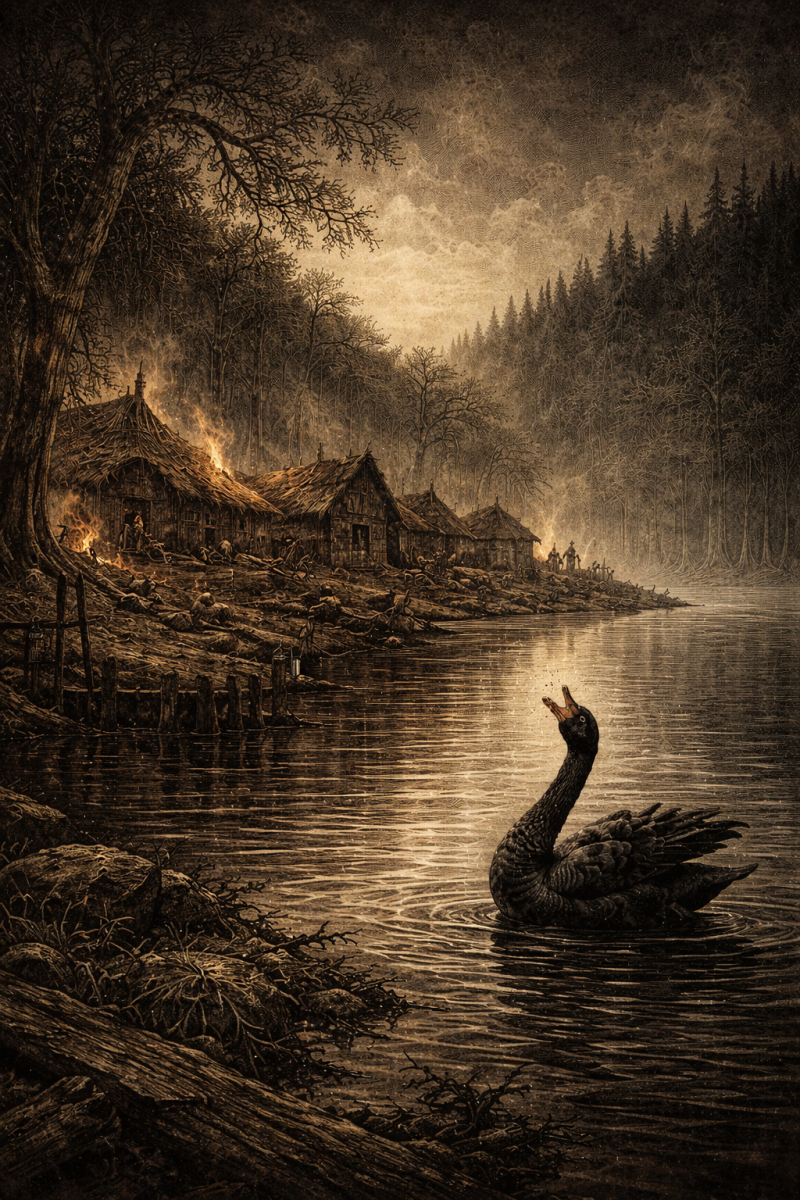
The village at the southern edge of the forest had been sorely mauled. Many were dead. Fear hung over the place like smoke after battle. Yet life remained there still, and with life the stubborn instinct to aid those who might yet stand against the dark.
So when evening came, a villager led the knights down to the water and showed them a small boat which they might borrow on the morrow to reach the isle.
There at the lakeshore, as the day failed and the last light thinned upon the water, they saw a black swan drifting far out upon the darkening surface.
It raised its beak and sang.
And as soon as that song was heard, night swept over the lake and shore in an instant, as though the world had been covered by a great black hand. The villager cried out in terror and fled at once from the waterside. Nor did the knights linger long themselves, for this was no natural dusk, but a sign and a warning. They returned swiftly to the village and set about barring doors and strengthening what shelter they could before the darkness fully settled over them.
There the session came to its close: with the evil isle still waiting, the borrowed boat promised for dawn, and the black swan’s song lingering in memory like a curse not yet fulfilled.
Thus ended the third passage of their chronicle: with one companion taken by the forest, one youth drawn living from a prison of bones, graves given to the fallen, and night itself called down by the song of a black swan.
Add comment
Comments